Solid Surface & Quartz Stone Since 2000 - GELANDY 
Language
Solid Surface & Quartz Stone Since 2000 - GELANDY
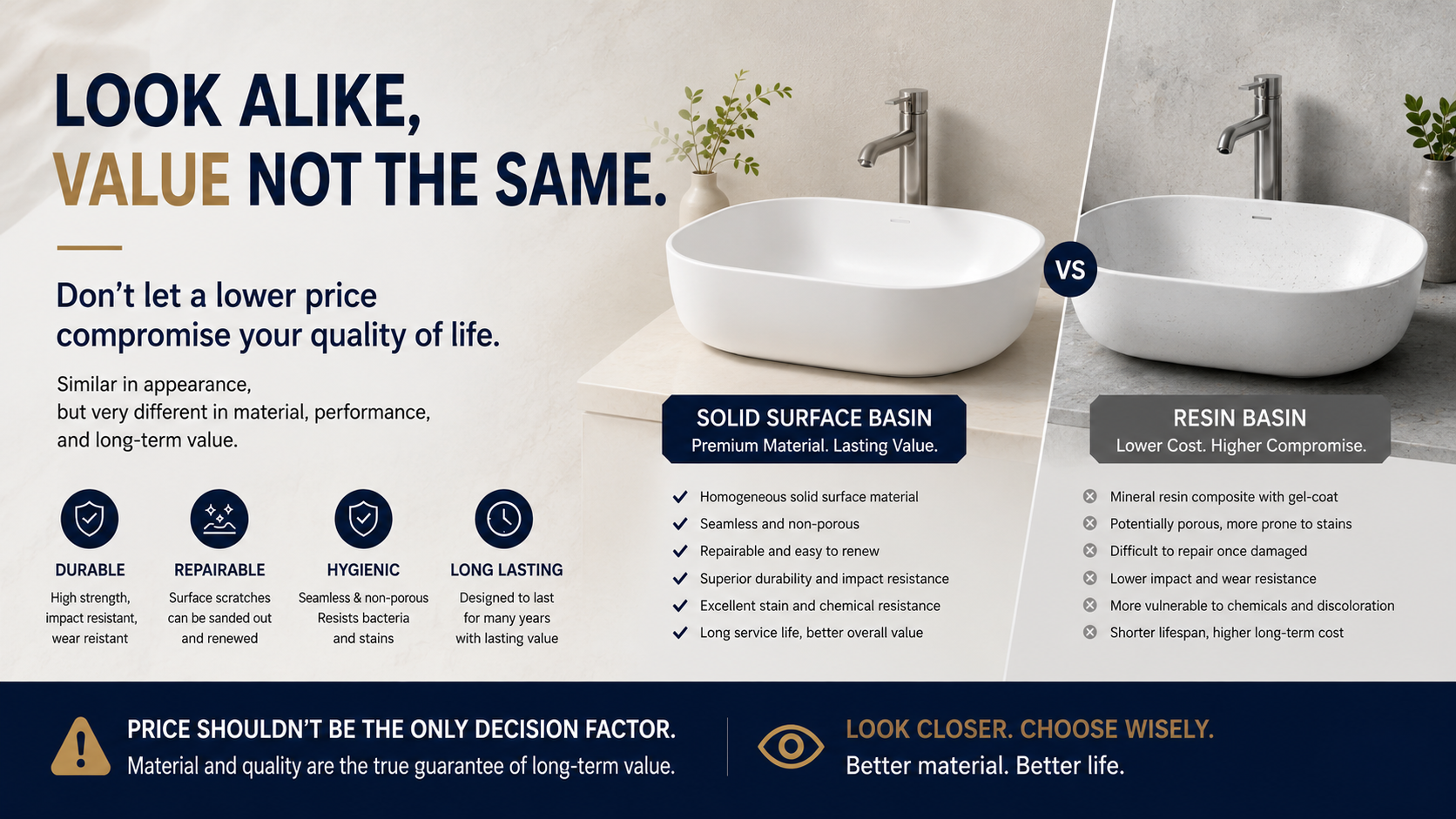
Solid surface basins are positioned as a premium category in the sanitaryware industry, valued for their seamless finish, durability, repairability, and long service life,and customization. They are widely used in residential, hospitality, and commercial projects where both aesthetics and long-term performance are important.
However, in recent years, as price competition in the basin market has intensified, some manufacturers have introduced mineral resin basins (often referred to as gel-coat composite or stone resin products). These products are designed to closely resemble the appearance of solid surface basins while using lower-cost materials and simpler manufacturing processes, resulting in a significantly lower price point.
Although they may look similar at first glance, the differences in material composition lead to clear distinctions in durability, surface performance, and long-term value. For this reason, it is important for buyers to carefully evaluate specifications and material definitions rather than making decisions based on appearance or initial cost alone.
·
In the industry, mineral resin basins are often marketed under various names such as:
·Mineral resin basins
·Stone resin basins
·Gel-coat composite basins
·Mineral composite basins
The term “resin basin” is commonly used as a commercial shorthand rather than a strict technical definition. These products typically consist of mineral fillers (such as calcium carbonate or stone powder) combined with polyester-based resin systems, finished with a surface gel coat layer.
1. Material System and Structural Design
·Solid Surface Basins:
Solid surface materials are engineered as a homogeneous, through-body composite material, typically based on:
Acrylic-based resin systems (MMA and/or modified acrylic systems)
ATH (aluminum trihydrate) mineral fillers
Uniform, non-layered internal structure
A key characteristic is that the material remains consistent throughout its entire thickness, enabling long-term stability and renewability.
·Mineral Resin Basins (“Resin Basins”)
Mineral resin basins are typically produced using:
Polyester resin or modified polyester systems
High loading of mineral fillers (calcium carbonate, stone powder)
A separate gel coat surface layer
This results in a layered composite structure, where the surface finish and the internal body are not identical materials.
2. Structural Stability and Cracking Behavior
·Solid Surface
Due to its homogeneous structure:
Stress is evenly distributed throughout the material
No distinct surface layer interface
Better resistance to thermal expansion stress
Lower probability of long-term hairline cracking
·Mineral Resin Basins
Due to the layered construction:
Differential thermal expansion may occur between gel coat and base material
Internal stress can accumulate at material interfaces
Hairline cracking may develop over time, especially in high-stress zones
Surface gel coat aging can lead to visible surface defects
3. Repairability and Lifecycle Performance
·Solid Surface Advantage
Solid surface is widely recognized for its lifecycle renewability:
Surface scratches can be sanded and refinished
Minor damage can be locally repaired
Material can be restored close to original condition
Suitable for long-term commercial and high-traffic applications
·Mineral Resin Limitation
Mineral resin basins are generally more limited in repair performance:
Surface is dependent on gel coat integrity
Deep polishing may expose base material
Repairs are typically cosmetic rather than structural
Limited long-term refurbishment capability
4. Aging Resistance and Color Stability
·Solid Surface
Stronger resistance to discoloration over time
More stable performance under humidity and cleaning chemicals
Better long-term aesthetic consistency
·Mineral Resin
Gel coat may show aging effects over time
Potential yellowing or dulling under long-term exposure
Performance strongly dependent on resin formulation quality
5. Mechanical Behavior
·Solid Surface
Higher toughness and impact resistance
More ductile failure behavior
Lower risk of brittle edge fracture
·Mineral Resin
Higher surface hardness in some formulations
But more brittle overall behavior
Higher risk of chipping under localized impact
6. Cost and Market Positioning
Mineral resin basins were developed primarily to achieve cost reduction while maintaining similar visual aesthetics to solid surface products. Key cost advantages include:
Lower resin cost (polyester-based systems)
High mineral filler content
Efficient molding processes
Reduced fabrication complexity
Solid surface systems, in contrast, are positioned as a higher-performance architectural material, with advantages in durability, repairability, and lifecycle value.
Conclusion
Solid surface basins and mineral resin basins may appear similar in design and surface finish, but they represent two different material philosophies:
Solid surface: a homogeneous, repairable, long-life architectural material system
Mineral resin: a cost-optimized, gel-coated composite system focused on aesthetic replication
From a performance perspective, solid surface generally offers superior long-term stability, repairability, and structural consistency, while mineral resin basins provide a cost-effective solution for large-scale and design-driven applications.
“GELANDY " is a senior well-known and excellent manufacturer in China specializing in R & D, production and sales of Solid Surface and Quartz stone.
READ MORE>>